
In Lamu County, on Kenya’s northern coast along the border with Somalia, droughts, floods, displacement and violent extremism have long fed into one another. Since 2022, the county government has worked to break that cycle by making peace a permanent task of local government. For this approach, Lamu County received the 2026 UCLG Peace Prize.
Background
Lamu County is a fragmented territory of mainland settlements, islands, forests and long sea routes, bordering Somalia and the Indian Ocean. The county is characterised by high climatic vulnerability, recurrent droughts and floods, geographic isolation, and limited infrastructure, which significantly affect access to services and governance. In Lamu County, host communities, Somali refugees, migrants and minority indigenous groups live side by side.
Regional instability, high youth unemployment, historical marginalization and the presence of Al-Shabaab in the border areas leave this diversity vulnerable to conflict. During droughts and floods these pressures converge: competition over water and pasture grows, grievances are amplified and young people become more vulnerable to extremist recruitment. For a long time, the response was reactive and driven by outside actors.
The Project
Lamu County set out to make peace a core function of local government rather than a series of projects. To do so, it brought peacebuilding, disaster risk management, social cohesion and the prevention of violent extremism together in one framework.
The foundation is legal. In 2022, Lamu became the first county in Kenya to legislate peacebuilding as a core governance function, through the Lamu County Peacebuilding and Conflict Management Policy and Act. The law was developed from 2020 onward with members of the County Assembly from across the political spectrum, civil society, religious leaders, indigenous elders, and women’s and youth groups. It was drafted under one administration and signed by the next, so it has already outlasted a political transition. A Directorate of Peacebuilding leads its implementation, and peace goals are part of the county’s development plan and annual budget.
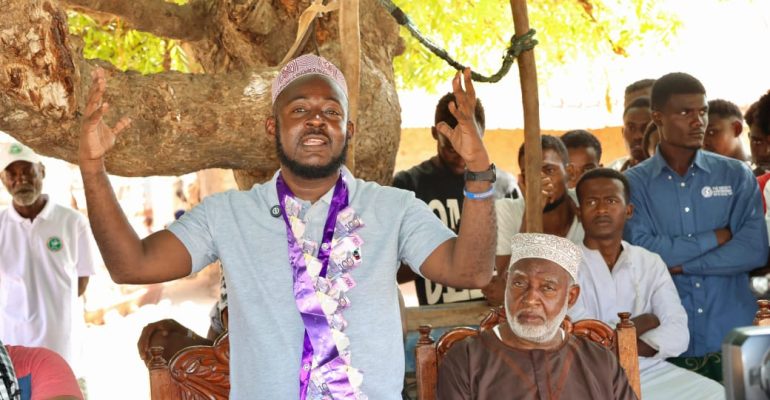
The Act creates a “peace architecture” that reaches from the county down to the village. Peace committees at village, ward, sub-county and county level bring together elders, religious leaders, youth, women, businesspeople, civil society and local administrators. They mediate land and resource disputes, watch for early signs of tension and link remote villages to the county during crises. Separate caucuses give youth, women and elders a formal voice. A joint committee co-chaired by the Governor and the national government’s County Commissioner connects county and national actors.
What sets Lamu apart is how closely peace is tied to disaster management. County departments must have their plans reviewed for conflict sensitivity. The water department, for example, cannot drill a borehole without checking that its location will not spark clashes between pastoralists. A single procedure for all hazards feeds into the county’s Emergency Operations Centre. When drought pushes herders into farming areas, the centre tracks the movement and triggers humanitarian aid and mediation at the same time. At sea, fishermen and boat operators have been organized into safety networks that report suspicious vessels, piracy and illegal fishing, building trust with the Kenya Coast Guard Service.
Inclusion is central. Young people are treated as peacebuilders rather than security risks. They take part in early warning and peace messaging, and Kick for Peace uses football to bring together youth from Kiunga in Lamu and Ras Kamboni in Somalia’s Jubaland State. The Women Peace Caucus leads grassroots mediation and cross-border dialogue. In Kiunga, the county has chosen community-based integration of Somali refugees over camps. Refugees share access to water, land and livelihoods, and migrant representatives sit on local peace committees.
The work has continued despite landmines and improvised explosive devices planted by Al-Shabaab, and storms that make sea travel unsafe. Thousands of residents have benefited. Communities where disputes once flared during droughts and floods now resolve problems through early warning and dialogue. The initiative is funded mainly from the county’s own budget. Neighboring counties have visited Lamu to learn from its approach, and since late 2025 authorities in Jubaland have begun adapting the model in Ras Kamboni and Kismayo. Lamu shows that even a remote, under-resourced county on a volatile border can make peace a permanent public service.