
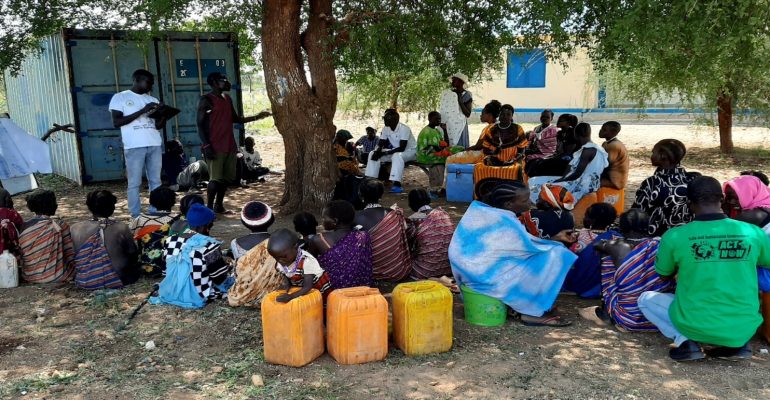
In Kapoeta North County, a semi-arid region in South Sudan’s Eastern Equatoria State, water is scarce for much of the year. Cattle herders and families collecting water for their homes depend on the same water points, disputes over the limited supply can easily turn violent. Since 2021, the county government has worked with communities to change that. Water points are now shared by agreed rules and run by local committees, and disputes are settled peacefully.
Background
Kapoeta North County is home to around 160,000 people spread across nearly 5,800 square kilometers. Life revolves around cattle: livestock is the main source of income, and meat, milk and sorghum are the staple foods. Rain falls mainly between May and September. For the rest of the year the land is hot, dry and dusty, and water becomes a matter of survival for people and animals alike.
Since South Sudan’s independence in 2011, the county has seen recurring conflicts at water points between livestock herders and domestic users. Scarcity, growing numbers of people and livestock, a changing climate and differing customs all play a part. Every broken pump means longer queues at the remaining sources, and longer queues mean more tension. The county could not simply build its way out of the problem. Communities would have to share responsibility for their water, so that technical problems would not become social breakdowns.
The Project
With support from VNG International’s Sustainable Development through Improved Local Governance (SDLG) program, the county set out to make communities self-reliant in preventing and resolving water conflicts. Together with herders and households, it agreed on rules for who uses water points and when, with separate schedules for livestock and domestic use. New water points were built to ease pressure on crowded sources.
Day-to-day management lies with Water Management Committees: elected bodies that include both herders and domestic users. They collect modest user fees, organize repairs, enforce local bylaws and mediate disputes before they escalate. Payam WASH Forums bring together the committees of each area, resolve conflicts that go beyond a single water point, and report to the county. To keep the pumps running, the county set up the Kapoeta North Pump Mechanics Association, a network of trained local mechanics, and harmonized repair fees across the county.
Women have a guaranteed place in this system. In line with national law, at least 35% of seats on committees and forums are reserved for women. Women in WASH groups give them a formal platform to make their voices heard. Training traditional leaders on gender equality even led to women being included in traditional courts.
The county holds the system together through monthly coordination meetings, community consultations and regular social accountability meetings. At these meetings, users can question how their water services are run. Between 2021 and 2025, more than 3,000 people took part in the initiative’s activities, over 40% of them women. According to the county, conflicts at water points have fallen by 85%. The system relies on simple hand pumps, local mechanics and fees paid by users, so it is designed to keep running without outside funding. Kapoeta North shows that even in a highly fragile context, a local government can turn a source of conflict into a shared responsibility.