
Manabí, a coastal province of 1.7 million people in western Ecuador, was historically a peaceful region. Today it is among those hit hardest by Ecuador’s wave of violence. The Provincial Government has no authority over the police, so it chose to act within its own competencies. Its Peaceful Coexistence and Human Security Plan treats security as a question of social development, tackling the root causes that leave people exposed to violence and criminal recruitment.
Background
In recent years Ecuador has faced an unprecedented surge in violence, driven by the expansion of organized crime and drug-trafficking routes. By the end of 2025, Manabí had recorded 1,271 homicides, that is the highest in the province’s history. Behind these figures lies deep structural vulnerability. In rural areas, 88% of households lack one or more basic needs, and youth unemployment reaches 58% in some cantons. Between 2023 and September 2025, 420 adolescents from the province were deprived of liberty. Nearly 11,800 cases of intrafamily violence were reported in the same period, and 79% of the victims were women. Ecuador’s Constitution makes human security a duty for every level of government, but provinces do not command the police or the military. Manabí could wait for national intervention or act within its own mandate. It chose to act, complementing the central government rather than replacing it.
The Project
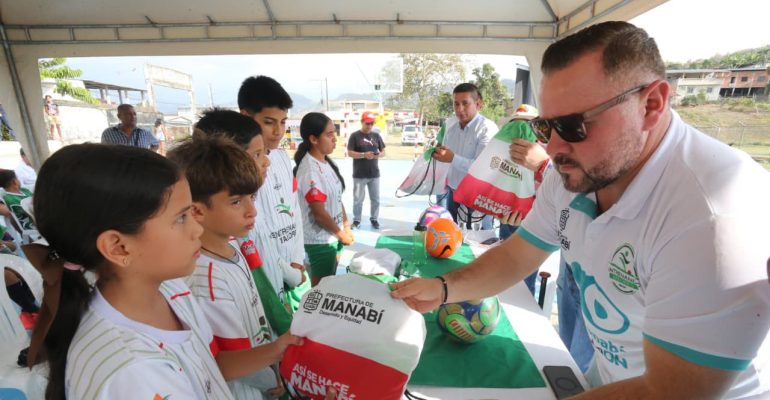
The plan is built on the Human Security concept introduced by UNDP, which aims to protect people from fear as well as from want. Each of its programs tackles one of these threats. Entrenando Valores (Training Values) runs sports academies for around 18,000 children a year, offering a safe alternative to the pull of criminal groups. Libre, vivir sin violencia (Free, Living Without Violence) provides protection, shelter and legal aid to women and children affected by violence. Operación Justicia Social (Operation Social Justice) sends mobile health and social brigades to remote rural communities, reaching more than 94,000 people a year. Escuelas del Productor (Producer Schools) trains farmers in sustainable agriculture, strengthening lawful livelihoods for thousands of families.
What sets the plan apart is how these programs work as one strategy. The Pacto por la Vida (Pact for Life) brings together many partners: the provincial government, the province’s 22 municipalities and its rural parishes, national institutions, universities, youth councils, civil society and international partners. A Provincial Security Council gives national and provincial authorities a single coordination table. A provincial observatory collects local data on violence so that policies can be tailored to each territory. Communities help set priorities through the participatory budget Yo Participo, which has run every year since 2019.
The approach is gaining recognition beyond the province. Ecuador’s Ministry of the Interior drew on the plan to develop a national methodology for local security planning. In 2025 the plan was also presented as a good practice at the Organization of American States. The plan is anchored in the province’s development planning and budget, and ordinances for the Pact and the observatory are in preparation. Manabí shows that intermediate governments without a police force can still lead on security, by investing in the conditions that make peace possible.